
From culture flask to paraffin block
A cell model takes several weeks and a small number of clearly separated steps.
-
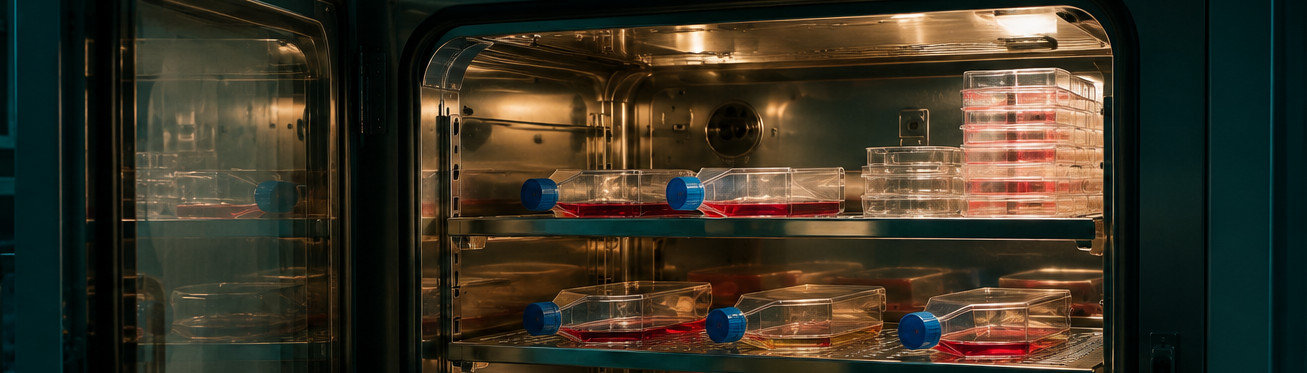
Culture and stock
A cell line is a population of cells that keeps dividing in the laboratory. It grows in nutrient medium at body temperature and is split once it becomes too dense. Part of it is frozen down and stored over liquid nitrogen, so that work can later start again from a defined state. -
Characterisation
What matters is not the name of a line but what it carries. Before use we determine which alterations are present and in what form. Since cultures can change over many passages, this is repeated as work goes on. -
Blending
Cells carrying a particular alteration are combined with unaltered cells. This reproduces what is normal in tumour tissue: only part of the cells carry the alteration. The ratio sets how hard it is to detect. -
Fixation and embedding
To turn a cell suspension into a block that can be sectioned, the pellet is set in a matrix, fixed in formalin, dehydrated and embedded in paraffin. This is the same process that has preserved tissue specimens for more than a hundred years. It leaves traces in the nucleic acids that can become visible during analysis, which is precisely why a model should go through the same treatment. -
Sectioning
Sections are taken from the block on a microtome and, depending on their use, mounted on slides or placed in a tube from which nucleic acids are later extracted. -
Measuring and recording
The proportion of altered cells is determined on the finished material rather than derived from the blending ratio, because the two can differ. Which method is suitable depends on the variant. What was measured, and under which conditions, is stated in the batch description.
What laboratories do with it
Anyone setting up a test procedure needs to know where its limits are. Material of known composition allows that to be determined without using up patient specimens. Later the same material serves ongoing monitoring: when comparable material is used over months, a shift becomes visible.
A further field of use is external quality assessment, where many laboratories examine the same samples and the results are compared. Such comparisons need larger amounts of uniform material.
Where the cells we work with come from is set out on the page Donating material.
What we hold to
- Traceability
- For every batch we record which starting material it was made from and which values were determined in the process.
- Defined starting state
- Work runs from frozen stocks, so that later batches go back to a documented state rather than to a culture carried on indefinitely.
- Measured, not calculated
- Figures for the proportion of altered cells are based on measurements of the finished material, stated with their spread.
- Retained material
- Where possible, material from a batch stays in house so that later queries can be answered on the same material.
This page describes the workflow in general terms. What applies to a particular batch is stated in its batch description.