
Cell models of human tumours
We grow human cell lines and build models from them: defined blends that reproduce the properties of tumour tissue that matter in the laboratory.
What this is about
When a laboratory examines a tissue sample for genetic alterations, it has to be able to rely on the procedure. That can only be checked against material whose properties are known beforehand.
An actual case is poorly suited to this. It exists once, the amount covers a few runs, and it is needed for the examination itself. Anyone who wants to check regularly, or to compare many laboratories at the same time, does not get far with it.

What a cell model is
A cell model is a blend. Cells carrying a particular genetic alteration are combined with unaltered cells in a defined ratio.
This reproduces a property of real specimens that regularly pushes test procedures to their limit: in tumour tissue, the alteration is never carried by the entire cell mass. Part of the cells belong to the surrounding tissue, and within the tumour itself not every cell carries the same alterations. The proportion decides whether a procedure still detects the alteration.
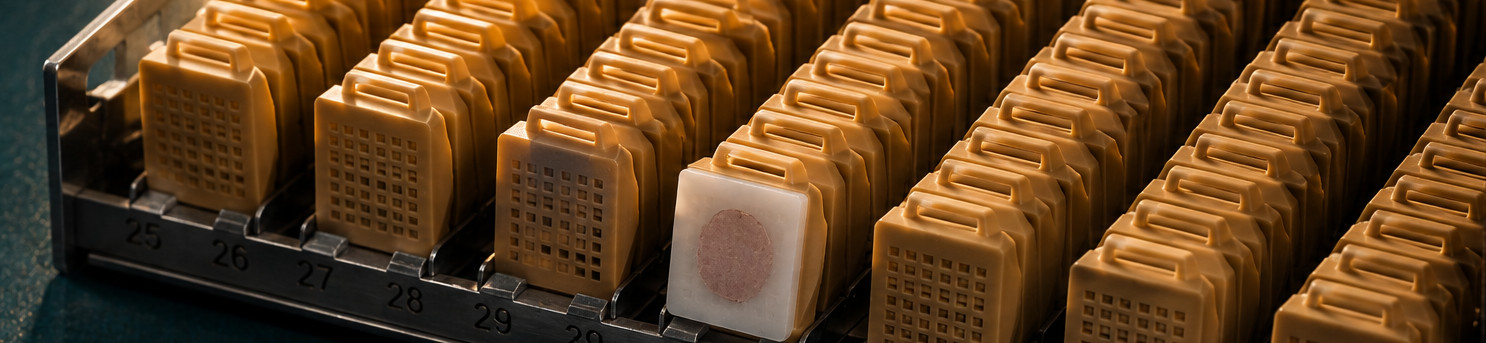
In a model that proportion can be set, measured and repeated. The material then takes the same route as a tissue specimen: fixed in formalin, embedded in paraffin, sectioned. One culture yields as much material as needed, and the same again months later.
What a cell model does not reproduce is the architecture of a tissue, its spatial arrangement and the variety of cell types within it. It is a model, not a substitute.
What goes into a batch
- Characterisation
- Before use we determine which alterations a line carries and in what form. Since cultures can change over many passages, this is repeated as work goes on.
- Defined starting state
- Work runs from frozen stocks, so that later batches go back to a documented state rather than to a culture carried on indefinitely.
- Blending and embedding
- Cells are combined in the calculated ratio, the pellet is set in a matrix, fixed in formalin, dehydrated and embedded in paraffin, that is, treated like a tissue specimen.
- Values from the material
- The proportion of altered cells is measured on the finished material rather than derived from the blending ratio. The measured value is stated with its spread.
Where the cells come from
Some of the cell lines we work with have been available from collections for decades and are used worldwide. Alongside these we establish our own lines. They originate from tissue left over after a completed examination, which patients have expressly made available for this purpose.
What this means in detail is set out on a page of its own: Donating material.
Where we work
Chiemgauer Zellkulturlabor GmbH runs a cell culture laboratory with attached processing in Ludwigstrasse in Traunstein.
For individual projects, target variants, proportions, formats and quantities are agreed beforehand. If you need something specific, write to us.
The material prepared here is used to develop and check laboratory procedures. It is not used to examine patients and does not replace any medical examination.