
Donating material that would otherwise be discarded
You have been asked whether a remainder of your material may be used for quality assurance in laboratories. This page explains, at your own pace, what that involves.
During an operation, a puncture or another examination, more material is regularly obtained than your diagnosis requires. Whatever is left over is discarded once the examination is complete. This remainder is what this is about.
Nothing changes for you. No additional procedure is carried out, no additional material is taken, and nothing about your treatment is altered. Your own examination always takes precedence; what is needed for it is decided solely by the doctor treating you or reporting your case. In case of doubt, nothing is passed on.
How it works
-
The consultation
You are approached by the doctor treating you. There you receive the detailed patient information, can ask any questions and have time to consider. We ourselves do not contact you. -
Your decision
You decide in writing and separately for each type of material. A refusal has no consequences whatsoever for your treatment and is not recorded. -
The handover
Only once your examination is complete and it is established that the remainder is no longer needed does it reach us. Your name is kept separate from the information about the material. -
In the laboratory
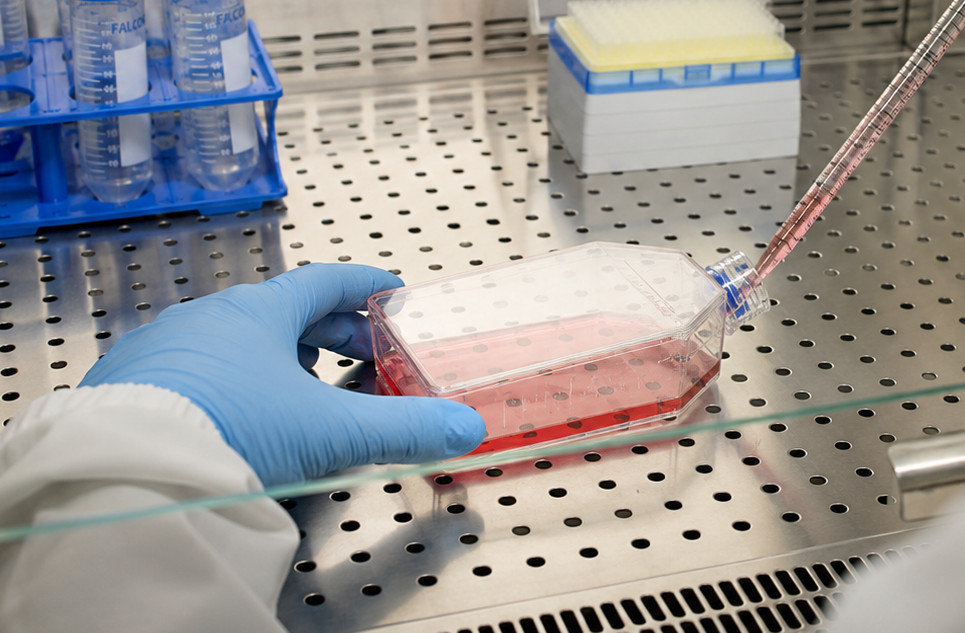
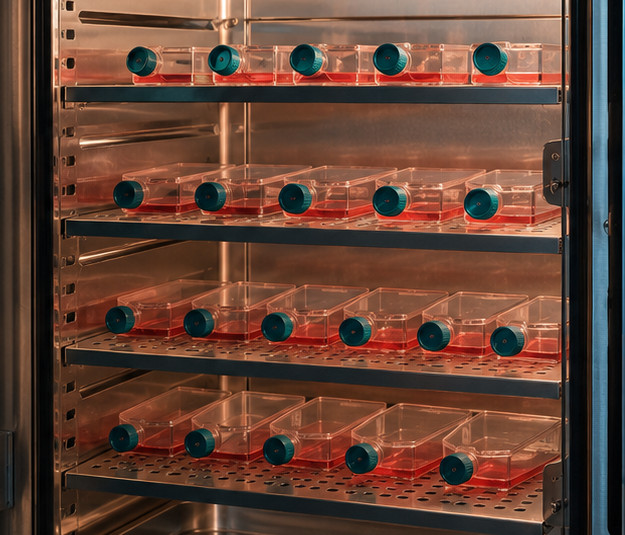
We attempt to establish a cell culture from the material, that is, cells that keep dividing permanently. The attempt does not always succeed; if it fails, the material is discarded. -
Afterwards
As soon as a permanent culture or finished samples have been obtained, the section bearing your name is separated off and destroyed. From that point on it can no longer be established whom the material came from.
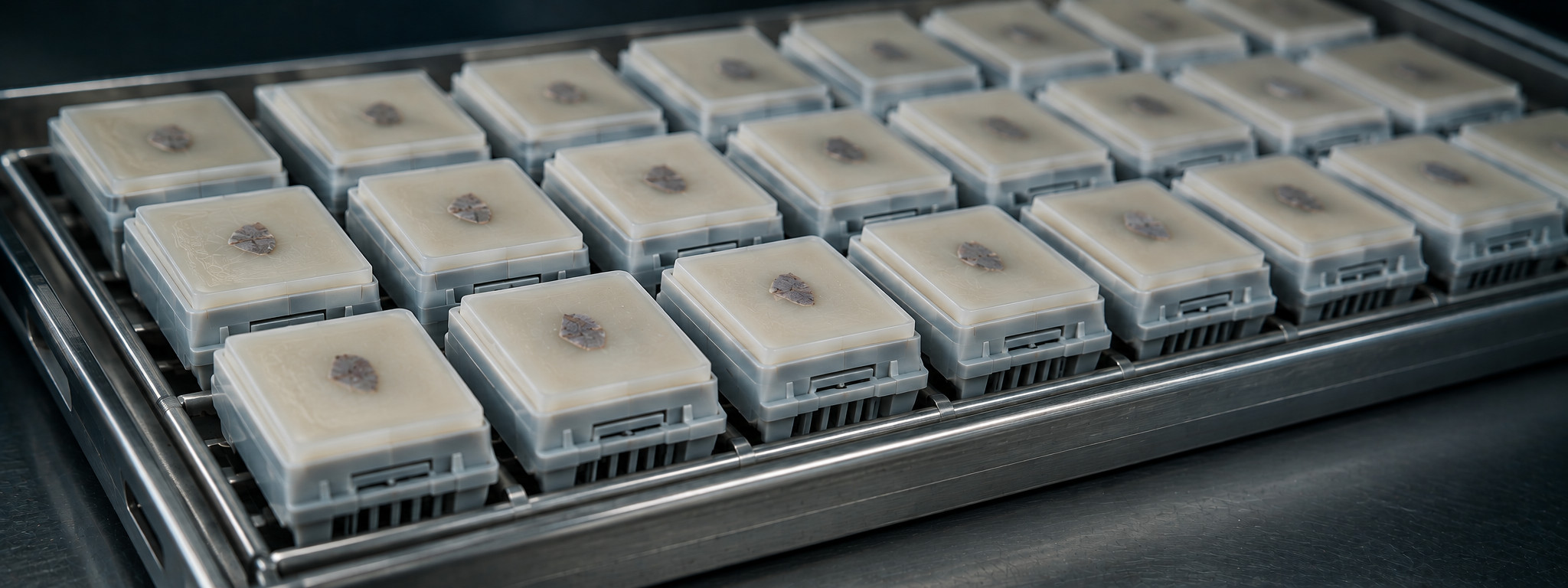
What the material is needed for
Whether a cancer can be treated with a particular medicine often depends on whether a specific genetic alteration is detected in the tissue. These examinations are demanding, and whether a laboratory works reliably cannot be judged from a single report.
Laboratories therefore check themselves regularly against samples whose properties are known beforehand. Real cell material is needed for that: it has to behave in the laboratory like a patient sample, to be available in many uniform portions, and to contain the property in question in a known amount. Cell cultures provide this over long periods. For rare alterations there is often no other source.
Your material serves as a tool with which test procedures are checked and developed. It is not examined in order to find out anything about you or your illness. Projects intended to produce findings about you are expressly not covered; those would require fresh information and your separate consent.
Frequently asked questions
- Is there any disadvantage if I decline?
- No. Participation is voluntary, a refusal is not recorded and has no effect on your treatment. You do not have to give reasons for your decision.
- Can I withdraw my consent?
- Yes, at any time, informally and without giving reasons. Material still held is then destroyed. There are two limits: samples already delivered cannot be recalled, and once your name has been separated from the material and destroyed, a withdrawal can no longer be implemented, because no one can establish which material was yours. When that point is reached is stated in the patient information you received.
- Do you learn my name?
- Your signed consent reaches us bearing your name, but it is kept separate from all information about the material and linked to it only by a number. Whoever works with the material in the laboratory does not see your name.
- What do you learn about my illness?
- As much as is needed to know what is being worked with: the type of tumour and which genetic alterations are already known in it. Without that information neither could a culture be established sensibly, nor could it later be described what a sample contains. What is not passed on is the pathology report itself, doctors letters, information about your treatment and about your further course. This information is not linked to your name.
- Is the material really anonymous?
- After separation it can no longer be attributed by us. Cell material can nevertheless never be fully anonymous, because cells contain genetic material, and genetic material could be attributed to a person if someone held a reference sample and compared it. We consider this risk very small, but we do not conceal it.
- Why a company and not a research institution?
- A good deal lies between a remainder and a usable sample: the cells have to be cultured, characterised, measured and documented, and every single sample has to demonstrably carry the same property. This effort is borne by the laboratories that later use the samples, which is why the samples are supplied for payment. Your material itself has no price that we could pay out to you, because the value only arises through this work. You do not share in the income, and no claims arise for you from it. We write this down expressly so that you can take it into account in your decision.
- Do the doctors receive anything for it?
- No. Neither the institutions involved nor the doctors involved receive money or any other benefit for making material available. This is laid down contractually, so that nobody has any reason to persuade you to consent.
- Do I receive results?
- No. This use produces no findings of relevance to your health, and no search is made for inherited predispositions. For questions about your own diagnosis, your treating doctor is the right contact.
- Who receives the samples?
- Providers of external quality assessment schemes, medical laboratories and pathology institutes, research institutions and manufacturers of test procedures, and institutions providing education and training, in Germany and abroad. Recipients are obliged not to seek to establish the origin.
This page is a summary of the consultation and does not replace it. What is binding is solely the patient information and the consent form in the version you received and signed.
If you have questions
The first point of contact is the institution where you were treated. They can reach us quoting the number shown on your documents, without your name having to be mentioned.
You can also contact us directly, including long after giving consent and including if you have changed your mind. The simplest way is the contact form, choosing the subject for questions about tissue donation. A message to info@chiemgauer-zellkulturlabor.de or a letter to the address in the footer of this page work just as well.
Please do not include any information about your health or any findings. The number from your documents is enough for us to process your request.